
The Sound of Forest in an Urban Rising
The Sound of Forest in an Urban Rising
“For a time, I rest in the grace of the world and am free…”
- The peace of wild things by Wendell Berry
A crisp breeze floods the campus premises this fresh morning. A symphony of trills heralds a new day, bringing about the routine hustle of students rushing to their classes and researchers racing against time to meet deadlines. Immersed in the punishingly demanding stresses of collegiate activities, they are often oblivious to an entirely different facet of Earthly life - the flora and fauna coexisting quietly with the research enthusiasts.
Nestled in the heart of the ‘Garden City of India’, the Indian Institute of Science offers a 400-acre haven for an eclectic mix of birds, insects, reptiles and mammals. A bird’s eye view of the campus reveals a serene, semi-forest landscape rife with majestic trees.
Whether one is a seasoned expert or a novice curious about plant and animal life, the bounty of nature curated and cared for in this institute is bound to catch the eye, inspire moments of appreciation and make one wonder about the umwelts far removed from the familiar construct of human life. Read on, take a figurative stroll and explore the rich repertoire of nature’s delights.
Stop 1: A fiery entrance.
Upon entering IISc, one is greeted by an array of Gulmohar trees standing guard on either side of the road between the JRD Tata Memorial Library and the IISc main building. Named Gulmohar Marg after its main attraction, the road is covered with a welcome carpet of reddish-yellow flowers in late spring – ‘tis the season to thrive when tiny flames sprout out on these trees to dance in the wind.
IISc has several such main avenues named after the prominent trees growing there, such as the Mahogany Marg, Silver Oak Marg, Amra Marg, Tala Marg, and Mandhara Marg. Only a handful of trees on the campus are native to Bangalore; others are of exotic varieties. Real Ashoka, sandalwood and Indian Laburnum are some of the precious inhabitants.
The CES mini forest boasts nearly 45 tree species from the Western Ghats (e.g. Western Ghats jackfruit). A gigantic liana - Entada rheedei Spreng – flourishes nearby, despite being difficult to cultivate outside of its native habitat.
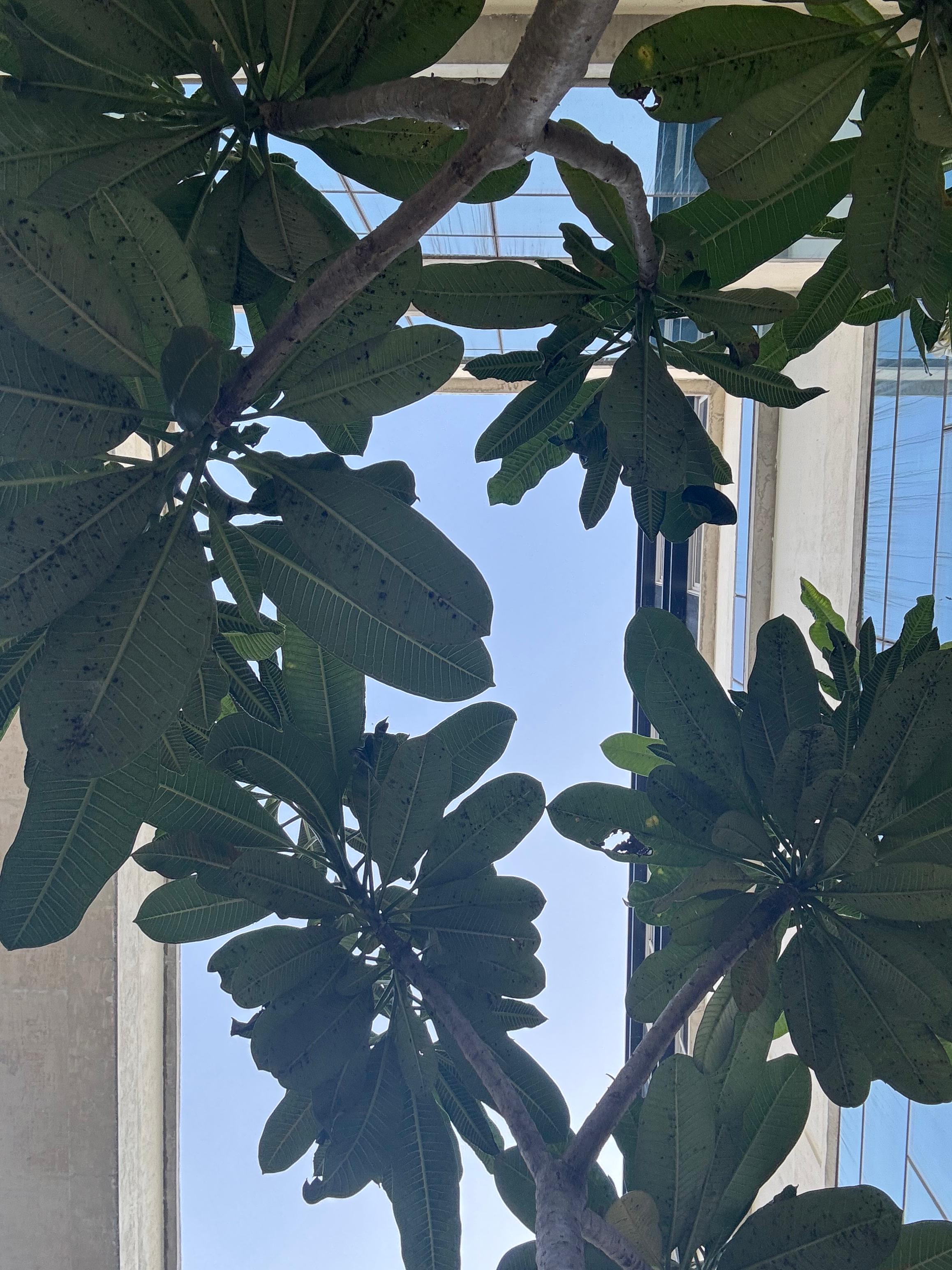
These massive trees help the rainwater to seep into the ground and provide cool shade from the scorching sun - forming a much-needed green oasis in the midst of a city undergoing rapid urbanisation.
Stop 2: The iconic landmark of IISc
Taking in the early morning air, one can next saunter into the IISc Main Building area. A quaint pond lies behind the towering building, cradled by colourful plants and dragonflies whirring about on their delicate wings. An invasive species of terrapin called the red ear slider can be spotted paddling away in the pond.
It is not uncommon to be startled by snakes slithering near the main building. In India, there are four major snakes that can cause death due to snake bites. IISc has two confirmed species out of the four, i.e. cobra and Russell’s viper. However, there is no reason to fret as the encounters are generally rare. Snakes are shy creatures and hardly come in the way of human activities. The rat snake, characterized by a long yellowish-brown body and a banded tail, is the most commonly encountered snake on campus. It is non-venomous and important for pest control. IISc also has the fossorial shieldtail, blind snake, sharp-toothed common kukri, and checkered keelback.
Skinks are snake-like lizards, often found sliding away in grass or leaf litter. Bronze skink, common garden skink, endowed with a bright red tail, and Golden Mabuya skink reside within the campus premises.
Among the geckos darting on trees, the common species include Jnana Slender gecko (also called as Knowledge gecko because of its prevalence in universities like IISc, NCBS, Jnana Bharti, etc.), Mysore day gecko, Termite hill gecko, House gecko and bark gecko.
Stop 3: A walk in the woods.
From the main building, a walk into the forest in the quadrangle offers a paradigm shift as one enters the lair of lush green canopy, upon being encircled by a mini woodland. Sunlight has a tough time navigating through the meshwork of leafy branches, and it forms dainty patterns of gold on the grassy ground. Herein, one can find butterflies basking in the warmth of the sun and fluttering about in the grass. There are ~ 67 species of butterflies on campus – ranging in size from the tiny Lycaenidae family to the large Papilionidae family. Common ones like the ‘Common Four-ring’ are found across the campus, while others like ‘Red Pierrot’ can be found only in certain selected pockets.
Both ground-dwelling and arboreal ants populate the area. Ants are one of the most diverse of in-campus insect species. More than ~100 species reside here, of which Dilobocondyla bangalorica and Tapinoma onaele are described from the campus itself! A substantial amount of ongoing research in the Centre for Ecological Sciences aims to investigate the mechanical properties of ant parts, their distribution pattern, their colony building and taxonomical description.
Stop 4: The nursery zone.
Following the trail of an adventurous butterfly may lead one to the adjacent nursery blooming with cultivated plants. The swimming pool area nearby is known for its bamboo patches and moist clusters suitable for fungal growth. A plethora of fungi can be spotted in damp soil littered with decaying matter, and on tree barks throughout the campus. Known by fancy names such as Bridal Veil Stinkhorn, Deadman’s fingers, King Alfred’s cake and Dog vomit Slime, the taxonomical identification of these fungi is an arduous field exercise for the mycophiles. Mushrooms are fruiting bodies of fungi, and they can often be consumed (at least once!). An interesting fact about mushrooms is that some have more than 17k sexes.
Stop 5: Jubilee Garden.
An exploration of nature is incomplete without a visit to the Jubilee Garden, known for its Acacia plantation. The tranquil pond of Jubilee houses the Indian Black turtle. In the past, an otter and a jungle cat have been spotted here. The campus shelters a variety of other mammals, including fruit bats, squirrels and bonnet macaque.
Owing to the semi – forest terrain in the midst of an urban area, a unique blend of both urban and forest–dwelling birds can be spotted here. From the fluting songs of Oriental magpie Robin to eerie hoots of Mottled-wood Owl to the dazzling Cormorants, the sounds and sights of the forest fill one with a sense of awe. Come winter, and the campus transforms into a birder’s paradise as the wintering birds start arriving. Forest wagtails sway on the floors of the forest in and around Jubilee, Ultramarine Flycatchers stud the trees near the University building, a mix of an amazing number of warblers, from Blyth’s reed warbler to Sulphur-bellied warbler, adorn all of the foliage in the campus, Indian Pittas add dazzle to the forest floors, while the Indian-paradise flycatcher set ablaze the forest canopy.
Creatures of the night
As the maiden of night softly drapes her star-studded cape over the azure of the sky, the nocturnal animals emerge to rule the dark. Nighttime is excellent for spotting forest scorpions with exoskeletons that glow in UV light, owls voicing scary screeches, droning cicadas, and enchanting fireflies seen in late June.
Slender Loris, a nocturnal primate, can be found in the CES mini forest area. This small mammal has large, brown eyes with reflective membranes. It once inhabited the shrubs and bamboos of Bangalore, but it is now rarely seen in the densely populated city. This mammal is protected by law and is one of the prime examples of how a green space can aid in the conservation of an endangered species.
Unfortunately, the ongoing developmental projects have imposed a survival pressure on many of the species on the campus. In a world turning grey with rampant construction activities, sustainability and conservation are not idealistic theories, but a pressing need of the hour that we cannot afford to do without.
Thus, we arrive at the end of our journey to make an acquaintance with nature’s children. If the murmurs of the forest dwellers and the wise whispers of the trees often leave you spellbound, do join the intriguing sessions and walks organised by the IISc Nature club and learn beyond the four walls of a classroom.
Info Credits: Kedar, Shakur, Subhasmita, Rahul, Utsav, Narashiman (IISc Nature Club)
References