4th Years in Conversation
The final year at IISc’s UG program is a time of crucial decisions, deep reflection, and a mix of pride, gratitude, and uncertainty about the future, as captured through interviews with nine diverse students.
4th Years in Conversation
The fourth and final year of IISc’s UG degree. The final step before graduation. Suddenly, a realisation dawns on all the students. They have to start thinking quite seriously about what to do after this. There are many hard and important decisions to be made, and they must be made quickly. Is academia the right choice for me? Should I stay on for a year in IISc and complete a masters, hoping to improve my portfolio? Is it too late to consider a change of fields at this point of time? What are my realistic chances of getting into a PhD program? Getting these answers wrong could have a permanent impact on many parts of their life.
It is also a time of reflection. People reminisce about their highs and lows, the things they got right and the things they went wrong. There is a sense of gratitude towards the students, professors and friends that built them up. There is pride in all that has been achieved during their time in IISc, and maybe a slight sadness at the thought of leaving it all behind. Though the paths they have followed are wildly different, putting them together paints a bigger picture of ambition, resilience, and the quality of the UG program at IISc.
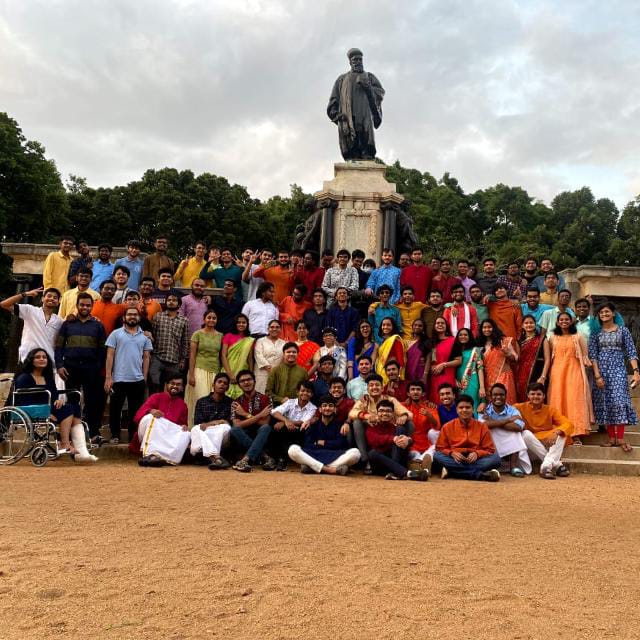
While it is difficult to describe all aspects of UG life accurately, we have attempted to capture some of the overarching themes through a series of interviews with 9 fourth-year students with wildly different backgrounds. The aim is to show off the amount of diversity and talent within these students, who are supposed to be the final products of the undergraduate program at IISc. At the same time, there is a focus on being realistic and showing a bit of the struggle and ugliness that lies below the success.
We thank all the interviewees for their participation and willingness to share their experiences and world views, and hope this gives an insight into what it is like to be a student in one of the most competitive institutions in the country.
Aditi
What is your major, and your specialisation within that major?
Aditi is a biology major who is interested in computational biology, where she works on the interface between computational neuroscience and AI. She is working on modelling human behaviour in response to a behaviour using neural networks.
If not this, what would you be doing and why?
“I guess something in CS perhaps, because I was preparing for IIT for a long time. Also, everyone in my family is a software engineer.”
If you had the chance to re-take your degree from the first year, what would you change and why?
“I guess I should have paid more attention to courses throughout my degree. I approached them more from a perspective of getting a good grade and less from a perspective of learning something. I think being in a survival mode or in a fight-or-flight mindset takes the joy out of learning. And you cannot always blame the student in all these situations, the degree can be quite challenging.”
What is the most difficult academic decision you have taken till now?
“I think my hardest decision was joining IISc. In my head, I always thought that I wanted to do engineering and IIT. It was a big change for me to consider IISc, and the more I considered it the more it seemed right for me. In the end, I was still unsure when I made the final decision, but now I realise that it was clearly the right choice for me.”
What are your plans going forward?
“I would want to do either a master’s or a PhD. Basically, I want to explore other aspects of computational biology and explore areas a bit beyond neuroscience. Eventually I want to be in an industry research kind of job.”
Sanyam
What is your major, and your specialisation within that major?
Sanyam is a materials major working on computational modelling and simulation. He works on modelling Aluminium and Titanium alloys and composite fibres, which have many applications in the aerospace and automobile industries.
If not this, what would you be doing and why?
Sanyam feels that he would have been a physics major if not a materials major. He is currently restricted in his research topic of combustion and avionics by the imposed condition on materials majors to choose materials-oriented projects for thesis. Physics as an umbrella major would allow for much more freedom in the choice of projects.
If you had the chance to re-take your degree from the first year, what would you change and why?
“I regret choosing courses that were not exactly relevant to my research interest but would get me a good grade. I should have chosen to take pre-requisite courses from different departments to build up my base of knowledge.”
What is the most difficult academic decision you have taken till now?
Before his school years, Sanyam had decided to get into IIT and pursue engineering. Eventually, he switched to IISc because of his inclination towards research. But there was apprehension from his parents because they hadn’t heard of IISc before. Having seen faculty and students in both IISc and top IITs since then, he feels that IISc was the right choice. “The students and professors here are really committed to finding something new in their field and enriching it.”
What do you think has been the biggest positive influence on your academic journey so far?
Sanyam really appreciates getting to meet so many influential and important personalities while in IISc. One of his best experiences comes from the humanities course ‘Introduction to Governance’ offered by Prof. Uday Balakrishnan, where he got to hold a panel discussion for a panel of esteemed people consisting of a retired Lieutenant-General, a retired IPS Officer and the DGP of Karnataka. He counts these privileges as perks of being at an institution like IISc. Personally, he feels he has been influenced a lot by the thoughts of Prof. Uday Balakrishnan, who himself is a retired civil servant.
What are your plans going forward?
Sanyam has given the GATE exam and is awaiting his results, hoping to get admission in an MTech program within IISc. He hopes to join the Public Sector Undertakings in aerospace (HAL, etc.) and work on developing fifth and sixth generation fighter jet engines for the Indian air force.
Sourabh
What is your major, and your specialisation within that major?
Sourabh is a mathematics major who is broadly interested in theoretical computer science, with a particular leaning towards the field of cryptography.
If not this, what would you be doing and why?
“If not math, I would probably have chosen physics. That was my idea when I joined IISc. But whenever I talk to a Physics major right now and ask them what they are doing, it just feels so uninteresting to me. So, I feel like I made the right choice. But anyways, I wouldn’t have stuck to pure mathematics either way.”
If you had the chance to re-take your degree from the first year, what would you change and why?
“I would probably still choose math as my major. One thing I feel I am lacking in is a general level of knowledge in other subjects. I have a broad interest in science, and I want to keep in touch with some of the non-mathematical subjects like electrical engineering. That is something I feel I need to work on.”
What is the most difficult academic decision you have taken till now?
“While choosing my major, I was very stressed. But I think the most difficult part has been trying to decide what to do after these 4 years.
There is a tendency to sort of ignore what to do after this degree, partly because of this attitude that if you are in a good college, you will obviously get a good job. So, you keep postponing the decision until you can’t postpone it anymore.
Now you must make all the hard decisions, and it becomes especially difficult seeing how they affect all the people around you. For example, if you choose to do a Master’s that is not fully funded (which is often the case), then it requires a lot of financial and moral support from the family to pursue, which you didn’t need when you were supported by scholarships within IISc. Now you must think about earning money, and the timeline of your life.”
What do you think has been the biggest positive influence on your academic journey so far?
“One thing that comes to mind is talking to my mentor, Professor Vamsi. He has helped me a lot. I had doubts about choosing math major early on, and when I approached him, he would always sit with me for a long time and try to figure out some stuff.
At the very least, he would crack some jokes that would make me laugh. And yeah, family support is always very important.”
What are your plans going forward?
“I have told so many of my relatives about it, I almost remember the answer to this question now” (laughs).
Sourabh wants to either find a job that suits his profile, or stay on for a Master’s in IISc and use that time to align himself with CS.
“Right now, I am a math major with some CS knowledge, but maybe in one year I will be comparable to someone with a good BTech degree. I am also thinking that after getting some job experience, I can try and go for a PhD.”
Vinayaka
What is your major, and your specialisation within that major?
Vinayaka is a mathematics major who is mostly interested in the fields of algebraic geometry and representation theory, which involves the study of geometrical objects using algebraic methods, much of it dealing with systems of polynomial equations.
If not this, what would you be doing and why?
Vinayaka says that he would have taken a physics major if not for mathematics.
“I was sure on physics, then I switched to mathematics after 2 semesters. Personally, I did not like maths much in high school, and it was my worst subject in JEE. But after coming to IISc, I found the rigour and abstractness of the proofs in mathematics very appealing.”
If you had the chance to re-take your degree from the first year, what would you change and why?
“In my first year I did a project in astrophysics. With the benefit of hindsight, I would have chosen something more relevant to my studies, that would have looked better on my CV as a math major. I also regret not applying for internships more seriously.”
What is the most difficult academic decision you have taken till now?
Vinayaka says that choosing math as his major was a very hard decision that took him a whole semester to decide.
“There was a presentation in the math club Samasya which was held by a senior on algebra and topology. That was when I realised how abstract and fun math is … and that it was something I could really enjoy doing.”
What do you think has been the biggest positive influence on your academic journey so far?
“Definitely the people I study with. I have a friend group that I study with during exams. It is one of the biggest things that keeps me going and keeps me motivated.
Also, I talk to Professor Vamsi whenever I’m not feeling cheerful or motivated. I was sick and I missed almost the entirety of my fourth semester. He was really supportive and helpful during that.
Also, being involved with the Rhythmica community (which is the music club of IISc) gives me a place to get away from academics and helps me be happy. It gets me out of the monotonous loop of academics. That is something I recommend juniors to do as well.”
What are your plans going forward?
“The ideal situation for me would be to stay in academia and become a professor eventually. I want to at least give it my all until I finish my PhD. If it becomes too difficult or I stop finding it appealing, then so be it.
But I really want to give it my all for now. The problem with undergraduate mathematics is that you don’t really get to see the actual research done by mathematicians, I want to see that before I make up my mind.”
Oviya
What is your major, and your specialisation within that major?
Oviya is a physics major who works on 2D materials, namely graphene. She is currently studying the quantum Hall effect in graphene.
If not this, what would you be doing and why?
Oviya was initially really interested in theoretical physics before shifting to experimental physics. What made her switch?
“I think this happens with a lot of people, where you explore different things and realise what you like and also, what likes you, in some sense. I had only heard of people becoming famous in physics through theoretical physics before coming to IISc, so I hadn’t even thought of trying it until I took some projects that I really liked.”
If you had the chance to re-take your degree from the first year, what would you change and why?
“I really wish I had socialised more during the first year. I was in a new environment and not really accustomed to it after all. Later I realised that I didn’t need to be so scared.
Being in the physics major initially was also a bit challenging for me. It was easy to get intimidated by people who were very focused, and it also took time to get used to the heavily skewed gender ratio. What really helped is finding a group of friendly people that help each other and study together.”
What is the most difficult academic decision you have taken till now?
“Choosing experimental physics was hard for me. I had a completely different idea of what I was going to do in IISc, and I didn’t feel confident making that switch, because I thought I couldn’t do it back then.”
What do you think has been the biggest positive influence on your academic journey so far?
Oviya really appreciates the support from her friends and batchmates.
“I tend to doubt myself a lot. People’s encouragement and kindness were really really helpful. I also broke my leg last year, and I thought I couldn’t go ahead with the semester at all. But my friends were supportive, and they brought me notes from class almost every day.”
What are your plans going forward?
“I want to stay in academia and pursue a PhD in experimental physics. For me, the larger plan is to give back to academia. My colleagues, professors, and mentors have been extremely helpful and guided me a lot throughout my degree. I want to be someone like that for someone else down the line.”
Dhruv
What is your major, and your specialisation within that major?
Dhruv is a biology major with interests spanning the fields of AI, robotics, biological systems, and more. He is currently leading a startup working on, among other things, creating medical technologies to help in the early detection of postpartum haemorrhage, which leads to many complications and fatalities after pregnancy.
If you had the chance to re-take your degree from the first year, what would you change and why?
Dhruv says he wishes he had taken a degree in computer science to make things a bit easier for himself, since his core interests lie in that field.
“Taking biology while doing most of my work outside of biology has been difficult and has led to many irritating moments where people question why I work in so many technical fields while being a biologist.”
What is the most difficult academic decision you have taken till now?
“Choosing to come to IISc was a huge decision for me. There was a lot of opposition from my parents, who I never really argued with otherwise.
Another hard decision was to not pursue a master’s after my BS degree but to spend some time working on my startup and then go for a PhD.”
What do you think has been the biggest positive influence on your academic journey so far?
“I am grateful to some of my batchmates who have helped me through a lot of tough times, and to my parents for their guidance. I also really appreciate the professors and administration at IISc for providing me with a supportive and encouraging environment. I feel I have always managed to be confident because of this.
For example, having the freedom to go up to anyone on campus and being able to ask, ‘I want to do this, how will you help me?’ has been really empowering. I am also thankful to all the people who have shown an interest in me and become close friends and mentors.”
What are your plans going forward?
“I want to conquer the world!” (laughs)
“I want to keep working on projects that have huge impacts and high revenue returns. I want to help a lot of people while getting a lot of returns from it along the way.”
Aastha
What is your major, and your specialisation within that major?
Aastha is a physics major working in photonics, where she works on using photonic integrated circuits for applications in quantum technology, with applications in fields like quantum communication and qubit generation.
If not this, what would you be doing and why?
Aastha initially had a great interest in astronomy, from which she drifted away as she took more courses like Professor B. Suri’s Introduction to Quantum Measurement and Sensing.
She also enjoys studying mathematics but doesn’t want to pursue it as a career.
If you had the chance to re-take your degree from the first year, what would you change and why?
Aastha feels like she should have put in more effort into her lab work during the first three semesters.
“The stuff we did back then was actually quite interesting, and I wish I had taken it more seriously instead of working on things last minute. It would have been a lot more fun.”
She also feels that making connections with people in college is as important as academics, and she wishes she had focused more on that aspect.
What is the most difficult academic decision you have taken till now?
“There was a period of a few months between when I lost my interest in astronomy and took up quantum technology where I really felt lost.
I have always had certainty about what to do in academics throughout my life, and this was a new experience for me that was hard to go through.”
What do you think has been the biggest positive influence on your academic journey so far?
Aastha attributes a lot of her success to her father for all his hard work and sacrifice on her behalf. He stayed by her side and motivated her when she was most vulnerable.
“I hear from most students here that their parents were against their decision to join IISc. My father was fully behind me on that decision.”
What are your plans going forward?
Aastha plans on staying in academia and going for a PhD after her master’s at this point in time.
“There is a doubt always that you can do an MTech and try to get a job,” but she likes the intellectual satisfaction of research. She is always open to a change of mind.
Abhijeet
What is your major, and your specialisation within that major?
Abhijeet is a materials major working on fabricating an interesting material called Delafossite, which has unique magnetic properties. He hopes to use it to create more efficient storage devices.
If not this, what would you be doing and why?
“I really like the experimental part of my work, and I feel like I would still be doing that if I wasn’t doing research.
But if I hadn’t picked up research, I would be a coach teaching JEE material to kids in Kota, which is something I already do on the side.”
If you had the chance to re-take your degree from the first year, what would you change and why?
Abhijeet laughs and says he really wishes he didn’t have to take Biology in the first three semesters.
He would also choose his friends differently (not taking any names).
What is the most difficult academic decision you have taken till now?
Abhijeet was very conflicted between choosing IIT Bombay and IISc. He left the coveted CS stream at IIT Bombay because of his interest in research.
Though he came to know about IISc in 12th grade, he always had a plan to do a BSc, MSc, and then a PhD.
“I had this idea then that doing a BTech meant you would be unemployed. But now I know there is a difference between a BTech from IIT-B and a BTech from an unknown private institution.”
What do you think has been the biggest positive influence on your academic journey so far?
“My class 9 teacher is someone I admire a lot. He really motivated me to study and put this thought in my head.”
He is also deeply indebted to his friends from coaching centres who motivated him to study for JEE and really helped him prepare for it, even by giving him their own notes. Their selfless help and constant support made the difference in who he became.
“And of course, family support is really important.”
What are your plans going forward?
Abhijeet has an aim to open a JEE coaching centre in his city, to give kids a chance to get a good education in their hometown.
Towards that end, he is focused on achieving the financial benchmarks needed to make that happen.
He currently plans to pursue a master’s from IISc itself, and then either go directly for a research job in the industry or after doing a PhD, depending on the status of his applications.
Shelly
What is your major, and your specialisation within that major?
Shelly is a chemistry major working on theoretical and computational chemistry, a niche area that involves simulating chemical reactions and studying their mechanisms.
If not this, what would you be doing and why?
Shelly was very interested in automation in synthetic chemistry for a while—where tedious lab work would be outsourced to robots. However, she did not get great guidance or find good groups at IISc to pursue this interest.
Before choosing her major, her interests were split between chemistry, materials, and physics. She ultimately chose chemistry because she enjoyed studying it.
“I think a physics major would have given me a more technical background, which would be much better for exploring the fields I am interested in.”
If you had the chance to re-take your degree from the first year, what would you change and why?
Shelly would focus a lot more on academics. She would also be smarter about choosing assortment courses, avoiding ones that only sounded fancy, and take more advice from seniors.
“Chemistry major is really lacking in the number of seniors since so few people take it, which makes getting advice difficult, especially for people in physical chemistry.”
There were areas and departments she couldn’t explore due to ignorance.
“I feel like I underestimated the importance of GPA—for internships and even for PhD applications. GPA overshadows the other redeeming factors in your CV.”
What is the most difficult academic decision you have taken till now?
Shelly found choosing her major to be very hard, as it would affect so many decisions and opportunities.
Before joining IISc, she thought she would take a physics major. However, in her first two semesters, chemistry felt very easy to her, which confused her even more.
“Our seniors were also telling us that Materials was a very easy-going major, and scoring marks was easy. Now I’m glad I didn’t buy into that. But when the due date was near, the weight of the decision really started kicking in.”
What do you think has been the biggest positive influence on your academic journey so far?
“I feel that being in IISc itself has been the biggest positive influence for me. The people I interacted with and the experiences I had were wonderful.
Especially when I got to interview the former director of IISc, Professor P. Balaram, about IISc’s history at his own house while making a documentary for a humanities project.”
What are your plans going forward?
Shelly is currently worried about her PhD applications and various summer program applications.
She shares a sentiment common among 4th-year students:
“I really pray to God that I get a PhD offer soon.”